


Research
Bionanoelectronics : Nanoelectronics to measure biomolecules
Our laboratory builds nanoscale electrical circuits made of low-dimensional materials that are functionalized with biological macromolecules such as nucleic acids or proteins. Because of the extreme confinement of electrons in the nanomaterial, the electrical current becomes very sensitive to its immediate environment, allowing to measure tiny changes in the composition and arrangement of molecules at its surface.
Our overall goal is to exploit this sensitivity to understand biomolecular interactions in unexplored spatial and time scales, and to develop innovative biomedical instrumentation, especially for oncology.
Béraud et al. 2021 [1]
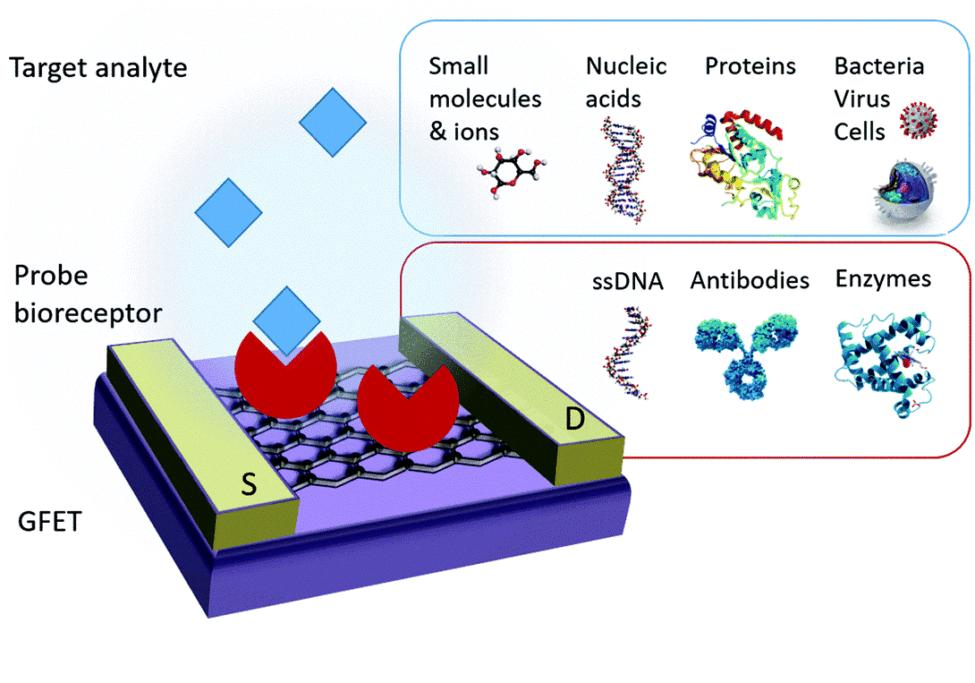
Bioanalytical GFETs
La bioanalytics is the science of quantifying a specific biologically-relevant molecule in a sample. In our lab, we study graphene field-effect transistors (GFETs), which are on-chip miniature electrical circuits made of graphene, functionalized with biological receptors such as antibodies or oligonucleotides to capture a specific biomolecule. In this design, the binding of target molecules is directly detected via a change in the electrical conductivity of the device, without requiring any optics in the instrumentation.
Our team works on understanding and controlling the different mechanisms governing the transduction of biomolecules capture into electrical signal, in order to optimize the sensitivity, selectivity and reproducibility of such biosensors. We also have several projects aiming to apply this approach to the detection of specific cancer biomarkers in leukemia and breast cancer.
Recent work : Beraud, 2021
Bouilly et al. 2016 [2]
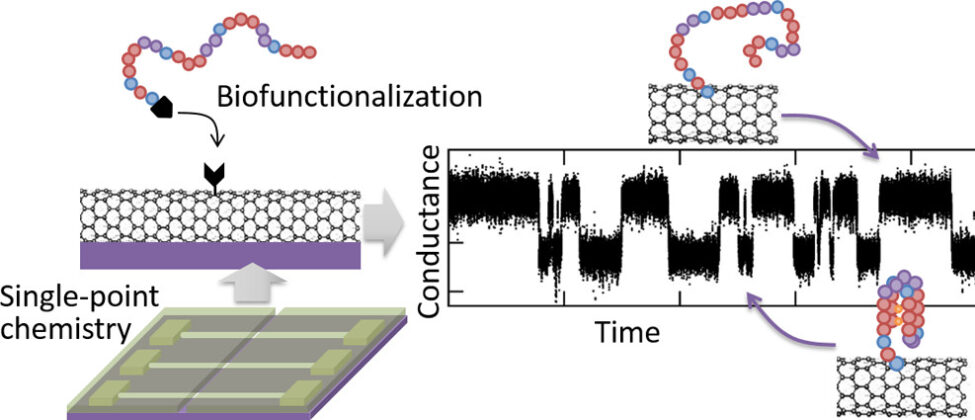
Single-Molecule CNTFETs
In contrast to ensemble bioanalytics, our lab also explores the extreme miniaturization of nanoelectronic sensors to probe biochemical activity at the single-molecule level. We can assemble single-carbon-nanotube field-effect transistors (CNTFET) that allow us to tether an individual biomolecule, such as a strand of DNA, directly to the nanotube. We can then record subtle conformational changes in that molecule as fluctuations in the electrical signal.
Such single-molecule measurements are interesting to decode the kinetics and thermodynamics of biomolecular interactions. In comparison to optical techniques, nanoelectronics sensors can combine nanoscale localization with high sampling rates, to access fast and rare molecular events.
Our group integrates efforts on device fabrication, signal analysis and computational simulations.
Recent work : Deraspe, 2026
Bazán et al. 2022 [3]
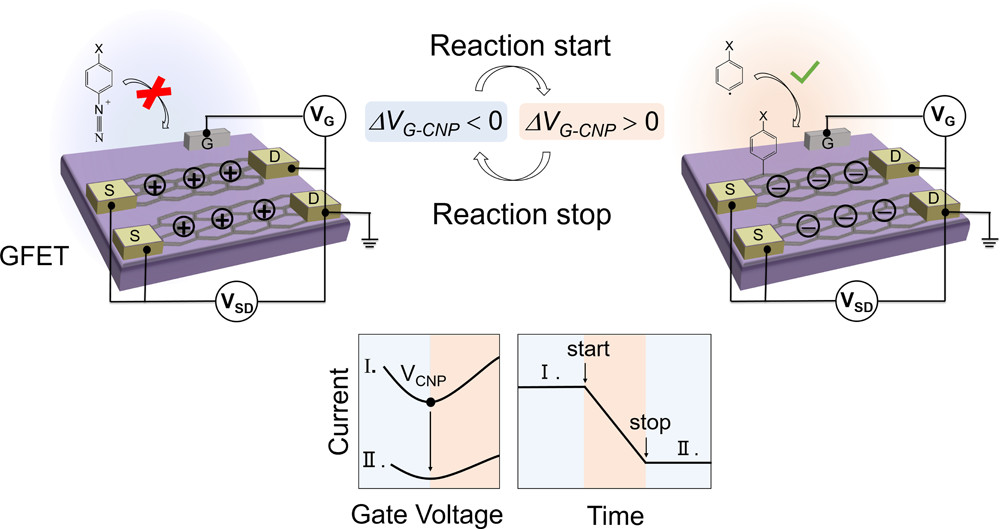
Surface Chemistry of Nanocarbons
Graphene and carbon nanotubes are our materials of choice to assemble biosensor chips. These 2D and 1D low-dimensional analogs of graphite present a high electrical conductivity that is strongly modulated by its molecular environment, making them exceptional sensors. These materials are also structurally robust in saline solutions, which is required when working with biological samples, and they can be chemically coupled to organic and biological molecules in several ways.
Our lab is always interested in developing novel approaches to control the surface chemistry of nanocarbon materials, in particular to control the distribution and orientation of biological molecules at the interface of the sensors.
Recent work : Bazan, 2022
Bencherif et al 2024. [4]
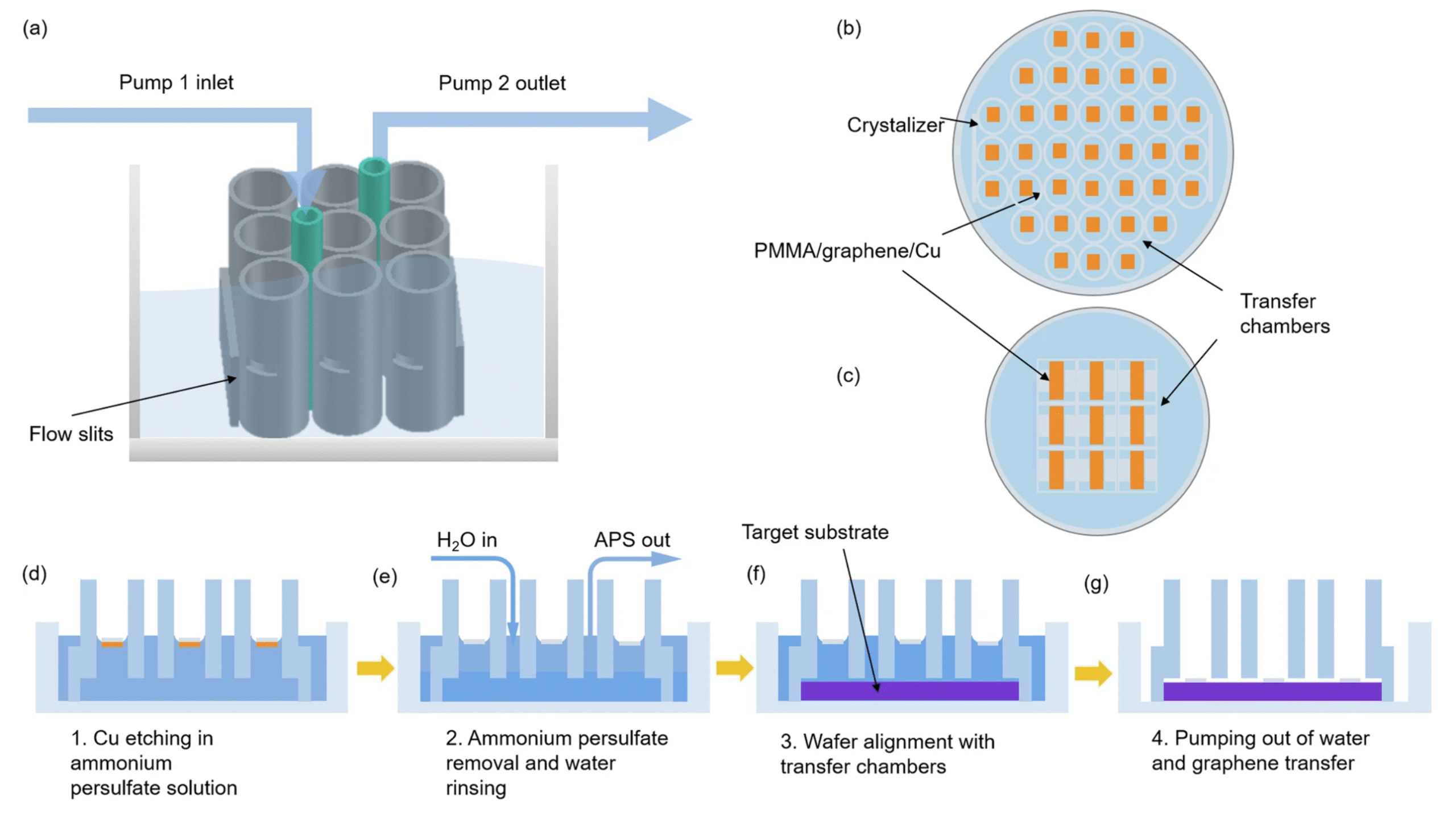
Creative Instrumentation
Our team likes to build custom and creative instrumentation and software. Sometimes there is no off-the-shelf solution available, or sometimes we want to have tools that we can customize to make original measurements.
We have in-house capabilities with 3D-printing, circuit design and basic machining, and we also have access to institutional workshops. We also collaborate with colleagues in computer sciences and robotics, to integrate automation and artificial intelligence in our workflows.
Recent work : Bencherif, 2024
This content has been updated on 13 March 2026 at 20h37.